
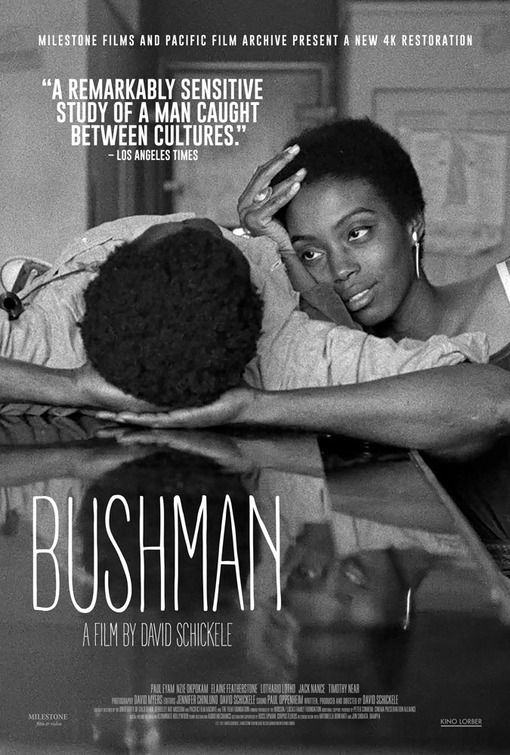
Community Curation: Bushman
- Sun, Nov 15
Midnite weekend screenings happen on Friday & Saturday nights,. so please be sure to arrive on Friday and/or Saturday night by 11:45pm for seating and the screening will start after midnight.
Director: David Schickele Run Time: 73 min. Format: DCP Release Year: 1971
Starring: Elaine Featherstone, Jack Nance, Lothario Lotho, Mike Slye, Paul Eyam Nzie Okpokam
This screening is the first iteration of a year-long curatorial residency at CONTOURS for aspiring racialized film programmers. This screening is curated by Gabrielle Warren.
1968: Martin Luther King, Robert Kennedy, and Bobby Hutton are among the recent dead. In Nigeria, the Civil War is entering its second year with no end in sight. In San Francisco, the adventures of Gabriel, a young Nigerian reflects tribal, personal, and racial frictions during the tumultuous sixties. Truth is stranger than fiction in Bushman, a rare sort of film portrait, part document, part imagined – poetic in its approach to real events.
What does it mean to exist between worlds, both physically and spiritually? Bushman begins with Paul walking on a road, shoes balanced on his head. The text orients the viewer to the time, listing those who have been assassinated in the United States (Martin Luther King Jr., Malcolm X, and Bobby Kennedy) and explaining the realities of the civil war in Nigeria. It is in its second year with no end in sight. We are then transported to San Francisco, and Paul is walking. He meets a man on a rickshaw and hops in. The rickshaw is labelled “Law and Order.” The driver asks, “you’re not one of ours, where do you come from?” Paul replies, “Nigeria.”
What I appreciate most about this film is the dancing between worlds. The film, as a concept, and Paul, as a character, refuse to fit into a neat box. Borrowing from William C. Anderson, the film plays on the anarchy of Blackness itself, refusing borders and categorizations. It finds humor and tragedy in that anarchy. What does it mean when we read Black presence as unorthodox? Paul’s position offers a lens on what many diasporic people experience daily: an ungeography. Yet, as Katherine McKittrick offers, the ungeographic does not mean place is not made, remade, contested, and reshaped. It exists within relation regardless of whether our “present order of knowledge” chooses to perceive it. -GABRIELLE WARREN
Followed by a live conversation between Gabrielle Warren and Saffron Maeve, with audience participation. An archival table of archival Black magazines gathered around the film’s themes will be open before and after the screening.
Doors Open 30 Minutes Before Showtime.