
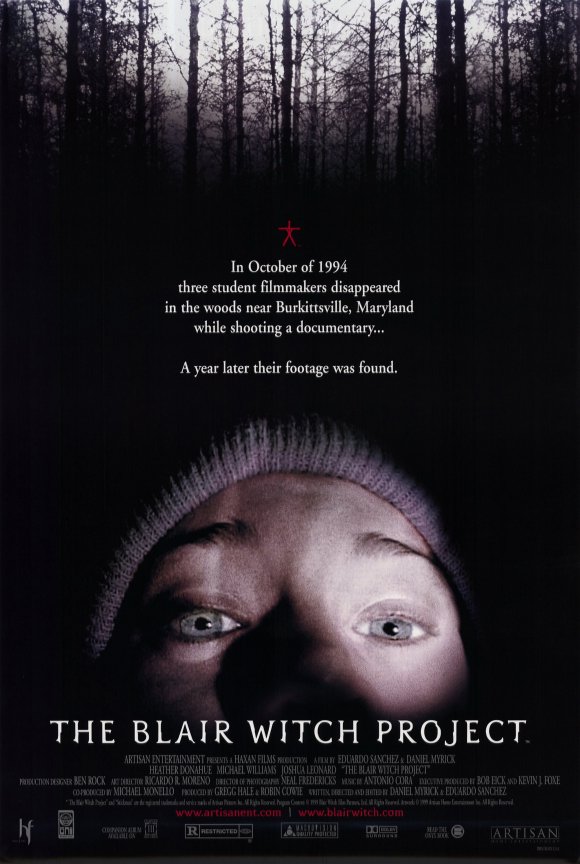
The Blair Witch Project
Midnite weekend screenings happen on Friday & Saturday nights,. so please be sure to arrive on Friday and/or Saturday night by 11:45pm for seating and the screening will start after midnight.
Director: Daniel Myrick, Eduardo Sánchez Run Time: 81 min. Format: DCP Release Year: 1999
Starring: Bob Griffin, Heather Donahue, Jim King, Joshua Leonard, Michael C. Williams
In October of 1994 three student filmmakers disappeared in the woods near Burkittsville, Maryland, while shooting a documentary. A year later their footage was found.
More than 25 years after its release, The Blair Witch Project (1999) is now widely acknowledged as a significant part of horror cinema history — so much so, perhaps, that some of its most radical elements may get overlooked today. However, when it was released, and indeed prior to its release, the film made a singular, indelible impact, one which has shaped so much about the films that have followed in its wake. This wasn’t only due to the tenacity of filmmakers Daniel Myrick and Eduardo Sánchez, who wanted to resurrect a feeling of real, childlike fear in their film (a sensation which had been eroded in the era of big-budget, big hitters like Scream and From Dusk Till Dawn). There was more to it than that: The Blair Witch Project owed a great deal to a strange coming-together of circumstances. Many of these things may have been beyond Myrick and Sánchez’s control, but they certainly used them in ways that elevated the finished film above many of its blockbuster genre-mates, and arguably changed the horror landscape forever.
In the late ’90s, society was on the cusp of a number of changes to how we communicated, recorded, and shared information, and not only does this find its way into The Blair Witch Project, but arguably lends the whole film a kind of veritas that would itself change dramatically as technology continued to develop in the years to come. Whilst it was made in 1999, the film is based on “found footage” from 1994; as it turns out, the mid-1990s was a watershed moment. Analog and older ways of doing things were still important (the documentary filmmakers are reliant on maps, a compass, and battery packs), but relatively new, lightweight camcorders now allowed for the whole idea of going to the woods to shoot a documentary in the first place. A few years either way, and this would have felt very different, if not seemed impossible. There was a purpose behind filming, and modern technology made the project doable. This is true of Heather’s proposed documentary, and the feature film itself. -KERI O’SHEA
Doors Open 30 Minutes Before Showtime.